Effort
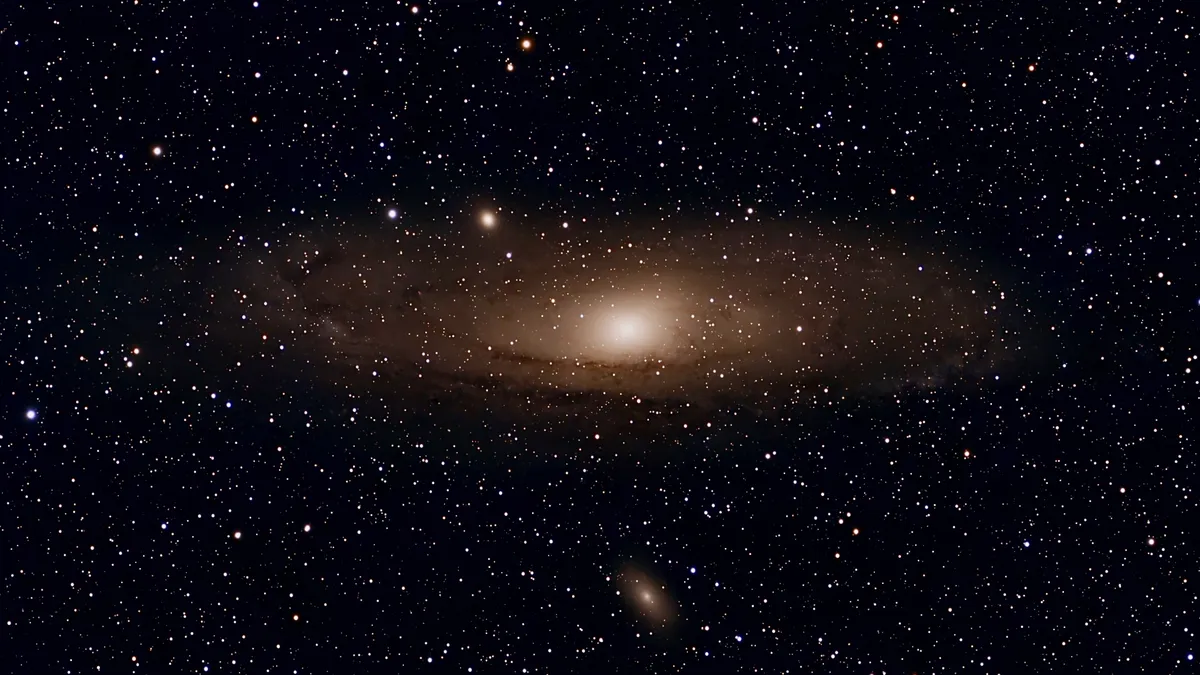
I took this photo and, at the time, I was amazed that such a thing was possible. I showed everyone and now I’m showing you.
The guilty secret is that I didn’t do anything. I placed a machine outside and pressed go.
Lately I am left wondering if the photo is even mine. Or worse, is it slop?
The photo wasn’t AI generated in the sense of a text prompt spewing out an image. It was taken with a SeeStar S30 Pro – a telescope/camera staring at a patch of sky for around 2 hours and compiling all the data into a single photo.
The SeeStar is so good and makes the process so easy the output might as well be generated. Would it matter if it didn’t actually do anything? What if it was all for show and pulled an image from the internet?
Here’s a photo of Andromeda from my larger telescope where I had to align, orientate, focus, frame, track, stack, and process.
Oh wait, I don’t have that photo. Doing it manually is hard and time consuming. Even though I live in an area with dark-ish skies (Bortle 4), my telescope appears to have a side-hustle as a cloud magnet.
I will do it one day but the point is, I haven’t. The SeeStar turns something that is hard into something that is disturbingly easy. But that leaves me detached from the process and I feel no love for its output.
Vibe Astrophotography
Generating images with AI gives a similar feeling. It’s fun for a while, friends share a few in-jokes, and then it’s boring.
The SeeStar isn’t ‘AI’ – despite the usual marketing guff – it automates and abstracts away all effort into a neat little package.
I make a request. Something amazing happens. The output feels less amazing than the process used to create it.
If anyone can do it and the result is the same, will other people find it interesting? The first few images, perhaps, but after then? No. It becomes boring. Slop-ish.
Adding Effort
The SeeStar has a couple of interesting features that can make life harder.
There are a couple of mounting options which change how the telescope points at the sky while the Earth rotates. Out of the box, the SeeStar will run in alt-azimuth mode (what you’re looking at rotates) but you can put it in equatorial mode (what you’re looking with rotates). EQ mode introduces around 5 minutes set up time but gives access to 20 and 30 second exposures.
Light is data. More light, more data, more detail, means better result.
Speaking of data, another feature will save every single image as .FITS files (raw data) allowing you to stack and process yourself.
Now we’re no longer relying on the SeeStar’s algorithms, we’re free to make something unique.
Stacking and processing is not straight forward. I have followed several guides and the results have been, to put it mildly, total shit.
But I’m happier with it. I have something that’s mine and I’ll get better at it.
Sweat and Tears
The reason I got the SeeStar was to encourage me to use the ‘proper’ telescope more. It can be disheartening to spend time setting up for the clouds to roll in three times in a week.
With the SeeStar I can get set up straight away and start gathering data while I’m faffing around with the big boy. If the clouds roll in then so be it, it won’t be wasted evening. If it stays clear then I will get to grips with the manual process and I will learn more through trial and error and effort. That will result in photos that I can be proud of and be happy to share. Whether other people find it boring or not.